
Multilingual website design (Arabic/English) 2026: When does your activity need it and how is it implemented correctly?

A contracting company operating in Egypt and targeting Saudi tenders. A clinic in Zagazig receives patients from the Gulf. An Egyptian store sells products to foreign customers. They all face the same question: Do I need a website in English as well as Arabic? The common answer: Yes — but incorrect implementation may do more harm than good, and lead you to technical problems and SEO errors that are difficult to correct later.
When does your business really need a bilingual website?
- Targeting customers outside Egypt: Saudi Arabia, the Emirates, the Gulf or foreign markets.
- It operates in the B2B sector in which it receives offers and foreign partners (contracting, manufacturing, export, software).
- You are recruiting talent and need a career page visible to the outside world.
- Your brand already works in two languages in documents and presentations.
On the other hand, if your business is purely local (home services within a city, a neighborhood pharmacy), a broken or blank English version may do more harm than good. It is best to focus your energy on overtaking your competitors in the same local market.
The correct technical structure: Where should the English version be placed?
There are three methods, and the results between them are great:
- Folders on the same domain (best recommended): mtm4web.com/en/ — brings all the power of a single domain into one place, and internal and external linking leverages each other. This is what we recommend for most projects.
- Subdomain: en.example.com — Acceptable and separates your audience, but partially separates the domain's strength and reputation in search engines.
- Fully separate domain: Only recommended for truly independent large brands with separate audiences (example: mtm.com and mtm.com.sa), otherwise it is an unjustified fragmentation of power and budget.
hreflang: still the dangerous forgotten link
Without the appropriate hreflang tag, Google may treat both versions as duplicate content or show the English version to an Egyptian user. The correct form is simple:
- On the Arabic page: a link to the Arabic version (hreflang="ar"), a link to the English version (hreflang="en"), and a default link (hreflang="x-default").
- On the English page: the same three in reverse.
- Links are identical for each page — do not link to the home page of service pages.
For sites that rely on automatic translation (Auto-Translation) in English, you should pay attention: Machine translation is accepted as a temporary solution for archiving or secondary domains, but it is not sufficient for commercial content whose goal is to convert the customer. Content that will actually be marketed must be human-written or reviewed.
Translation or Arabization? The difference that sells
A literal translation conveys the words; Localization conveys meaning and context. The difference appears in:
- Currency and prices: Don't display the price in one currency for everyone; Show customers in each market their prices in their local currency or clearly explain the conversion mechanism.
- Units and methods: Date, phone number, addresses, legal terms vary between countries.
- Communication invitations: “Order now” in the Arabic version; «Request a Quote» in English with a form compatible with the expectations of the English customer.
- Local example in the English version: Mentioning your projects in Saudi Arabia or the Emirates gives immediate confidence to the English reader in the same region.
How does a bilingual website help and not harm SEO?
- Meta titles and descriptions are written in the language of each copy and are not machine-translated — a machine-translated title is not competitive, and you can measure the status of your current copy via Free SEO Analysis.
- XML sitemap including both versions with hreflang tags.
- Slug links with keywords in the language of each version: for example “/web-design” and “/web-design” — do not use Arabic letters in the English version or vice versa.
- Original content, not duplicates: writing articles for each specific market, not just translating the pages themselves.
Technical details that the customer does not notice except in the event of an error
- Page orientation (RTL for Arabic / LTR for English) and its effect on menus, buttons and icons.
- Fonts: The same font family does not work in two languages; For each language, choose a font that displays the letters correctly.
- Layout: English text is 20-30% longer than Arabic — test them in the design.
- Links and guidance: Visiting an Arabic page from a foreign country should not be automatically switched to the foreign language without permission, but only display an easy suggestion to switch.
Cost and Duration
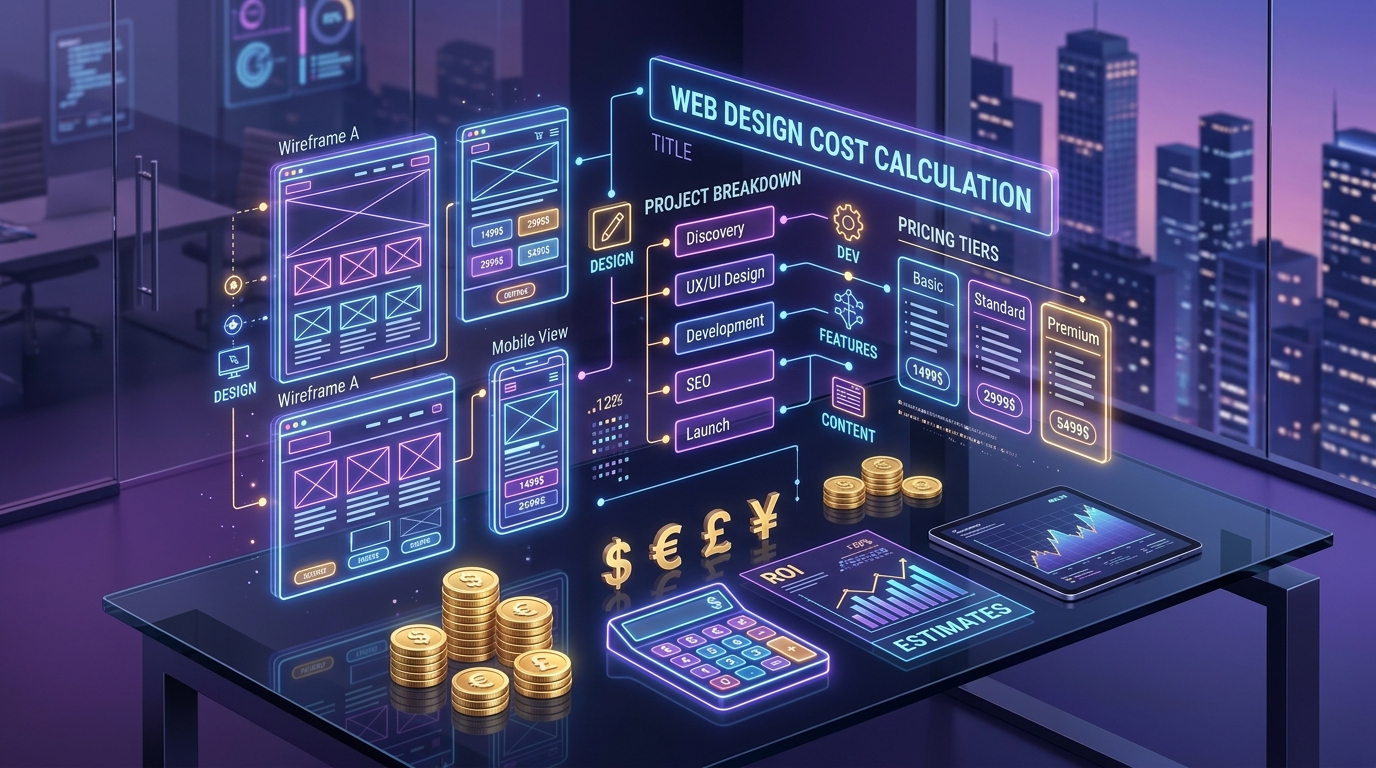
Building a bilingual website is not “multiplying the cost by two.” The architecture, design, and programming are done once, in addition to: writing or Arabizing the content of pages and articles, and adjusting the technical structure of hreflang and indexing. This is why the cost difference makes sense compared to the additional market size that the second version opens. For a quick estimate of your project budget, start by calculating your project price from Website Cost Calculator and mention in your “requirements” that you need a bilingual version.
Conclusion
A multilingual website is an investment in new customers, not a second copy of your website. The best thing to guarantee a real growth outcome is the right structure from the start: folders on your domain with intact hreflang, localized content not literally translated, and a user experience that respects each visitor's language. The MTM4WEB team builds bilingual websites for companies, stores and systems, and if you are planning to launch an English version or develop your current website to handle it properly, contact us to study the status of your website and send the detailed plan.
Audit & Accelerate Your Web Presence in Seconds
Website Cost Calculator
Instant custom estimate in SAR, EGP, or USD with timeline and scope breakdown.
Free Live SEO & Speed Audit
Test Core Web Vitals, TTFB, SSL health, and mobile friendliness instantly.
Latency & Speed Checker
Millisecond-level latency waterfall for DNS, TCP handshake, and download.
WordPress Theme Detector
Scan any website to detect active WordPress theme, plugins, and hosting.
Planning to launch your project or upgrade your website?
Our expert engineering team at MTM4WEB turns your vision into a fast, profitable digital platform. Get a free proposal and cost estimate within 30 minutes.
📚 Related Articles